
From mild blur to increased glare, vision changes caused by cataracts can affect how you go about your day. At Angel Eye & Cataract Centre, we can help you make sense of these changes and plan the right course of treatment in Singapore.
A cataract develops when the natural lens of your eye becomes cloudy. This lens sits behind the iris and helps focus light onto the retina, allowing you to see clearly.
When the lens loses its transparency, light no longer passes through cleanly. Instead of forming a sharp image, what you see may start to look less clear or slightly distorted.
Cataracts are most commonly age-related, but they may also develop due to medical conditions, long-term medication use, or previous eye injury.
Cataracts do not affect vision in just one way. Instead, they tend to change how your eyes respond to different situations. These are some of the most common ways people notice the difference in everyday life.

This is often the earliest and most noticeable change.
Rather than complete blur, your vision may feel like you are looking through a thin layer of fog or a lens that cannot quite be cleaned. Text may appear less sharp, and details may not come into focus as easily.
You may notice this when reading messages on your phone or trying to recognise someone across a room, where features appear softer than before.

This affects how your eyes respond to bright light.
You may find yourself squinting more in outdoor settings, especially under strong midday sun or when light reflects off roads and glass surfaces. Indoors, overhead lighting may feel harsher than usual.
At night, lights from oncoming cars may appear with halos or streaks, making it harder to focus on what lies beyond the light source, particularly when driving.

Seeing clearly in low-light environments may become more difficult. This often becomes noticeable in places like dim HDB corridors, car parks, or when moving from a brightly lit building into a darker outdoor area. It may take longer for your eyes to adjust, and edges such as steps or curbs may be less clearly defined.

Cataracts can affect how accurately you perceive colour. You may notice that whites appear slightly yellowed, and colours that used to look distinct begin to appear more muted. For example, it may be harder to tell the difference between darker shades of clothing, or images on screens may appear less vibrant.

You may find yourself needing new spectacles more often than usual. While a new prescription may improve your vision at first, the effect may not last. You may still find reading or watching television slightly strained despite having recently updated your lenses.

This is less common but can occur. You may notice a faint “ghosting” or overlapping of images when using one eye, especially when looking at high-contrast text such as subtitles or signboards. Covering the other eye does not remove the effect.
A proper assessment can give you clarity. Schedule your eye evaluation to find out what’s affecting your vision.

Cataracts are not defined only by what you see, but by how consistently these changes affect your vision.
In simple terms, early-stage symptoms tend to appear in specific situations, while more advanced changes are present most of the time.

In the early stage, changes are usually occasional and situation-specific.
At this stage, most people continue their usual routines, making small adjustments without thinking too much about it.

As cataracts progress, these changes become more constant across different settings.
At this point, the issue is no longer tied to specific situations — your vision may feel less reliable overall.
Not all vision changes require immediate treatment. The decision to see a specialist is usually based on whether your vision remains reliable, comfortable, and safe for your daily needs.
You may consider seeing a specialist if everyday tasks start to feel more effortful than they should.
This may include taking longer to read, needing brighter lighting at home, or finding it harder to recognise people or objects clearly without extra effort.
Driving requires stable vision, especially in changing lighting conditions.
If you feel less confident driving after dark — for example, needing to slow down more, sticking only to familiar routes, or avoiding night driving altogether — it may be time for an evaluation.
If your vision does not stabilise despite updating your spectacles, this may suggest that the issue is not just refractive.
Short-lived improvements or frequent prescription changes are often a sign that further assessment is needed.
If you decide to seek a specialist opinion, your eyes will be assessed in a structured and detailed way.
The aim is to confirm whether cataracts are present, understand how much they’re affecting your vision, and check for other eye conditions that may be contributing.
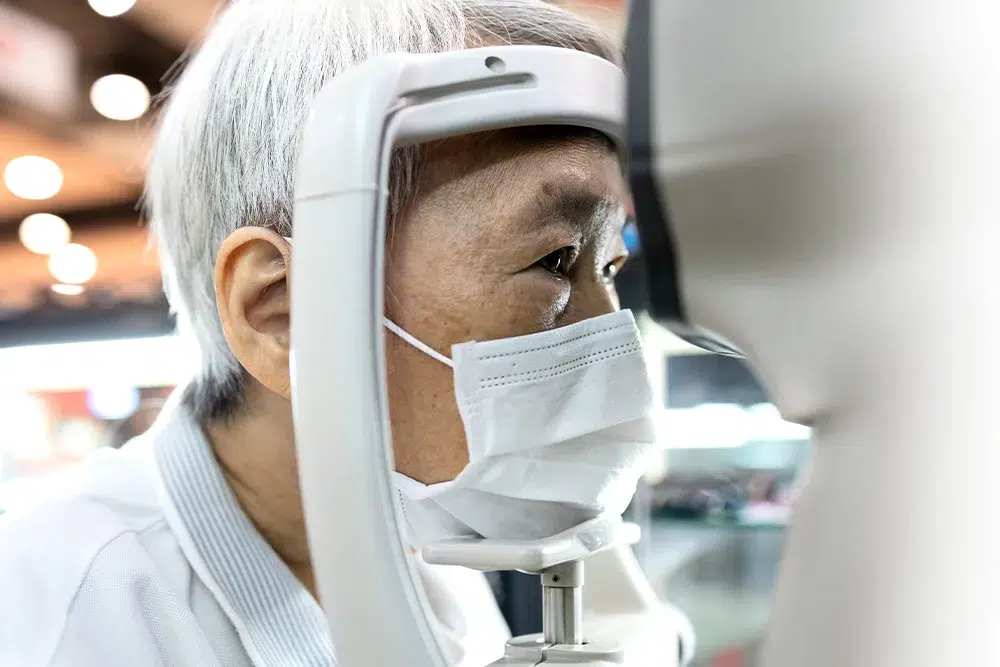
A microscope is used to examine the lens and other front structures of your eye in detail.
Eye drops are used to widen your pupils so the retina and optic nerve can be examined.
Measurements are taken to plan the appropriate lens if surgery is considered.
Over time, the cataract can become thicker and harder, which may make the procedure more technically complex. As the lens becomes thicker, the refractive index of lens changes, and the power or degree needed may change progressively, leading change of spectacles one after another.
Your vision may continue to decline, reducing the range of situations where you feel comfortable seeing clearly.
In many cases, cataract surgery in Singapore doesn’t need to be done immediately. However, delaying treatment may lead to gradual changes.
If cataract surgery is being considered, the next step is understanding the cost of care in Singapore. It typically varies, depending on:
MediSave and Integrated Shield Plans may help offset part of the cost.
If you would like a personalised estimate or guidance on your options, our team can walk you through the process.
Our friendly team is looking forward to serving you. For urgent enquiries and appointment requests, please call or WhatsApp us directly.
In the early stages, updating your spectacles may improve clarity for a period of time. However, this improvement is usually temporary.
Cataracts typically develop gradually rather than changing overnight. That said, you may notice more obvious differences once the changes begin to affect specific tasks, such as reading, driving, or adjusting to different lighting conditions. In some cases, the decline may feel faster simply because it starts to interfere more noticeably with your daily routine.
Cataracts do not usually cause pain. They affect how light enters the eye and how clearly you see, but they do not typically lead to discomfort, redness, or irritation. If you’re experiencing pain or sudden vision changes, this may be due to another eye condition and should be assessed.
Cataract surgery is generally considered when your vision is no longer sufficient for your daily needs, even with appropriate correction. This decision is based on how your vision is affecting your routine, rather than a fixed number or stage. A specialist will assess your condition and discuss whether surgery is appropriate based on both clinical findings and your personal requirements.
